
IDT CRISPR Solutions (gRNAs, Cas Enzymes, HDR Donors, Enhancers)

IDT product shipping costs from April 2024:
Depending on the synthesis location and shipping conditions, the following costs apply:
-
From Belgium: HUF 6,900 net
From USA: HUF 34,000 net
From Belgium, on dry ice: HUF 37,000 net
From USA, on dry ice: HUF 45,000 net
- Shipping costs for solutions depend on quantity and weight. Request a quote from Bio-Science Kft.!
General information on “custom” product groups from the IDT US manufacturing center:
Synthetic biology products:
- Genes
- gBlocks, eBlocks
- Ultramers
- RNA oligos
- CRISPR guide RNAs
- oPools
qPCR probes:
The synthesis location depends on sequence complexity and the chosen dye/quencher combination
Services:
- PAGE-purified products
Stock products:
A complete list is not available. Request a quote from Bio-Science Kft.!
- crRNA containing a specific sequence
- tracrRNA
- sgRNA containing both of the above sections
- fully customizable Custom Guide RNAs
- Cas9 V3
- Cas9 HiFi V3
- Cas9 V3 (glycerol-free)
- Cas9-GFP
- Cas9 nickase
- dCas9
- As Cas12a (Cpf1)
- Lb Cas12a (Cpf1)
Enhancers and Controls (on the Enhancers & controls tab of the link)
HDR donors:
Alt-R™ CRISPR-Cas9 and Cas12 system: new from Integrated DNA Technologies®!
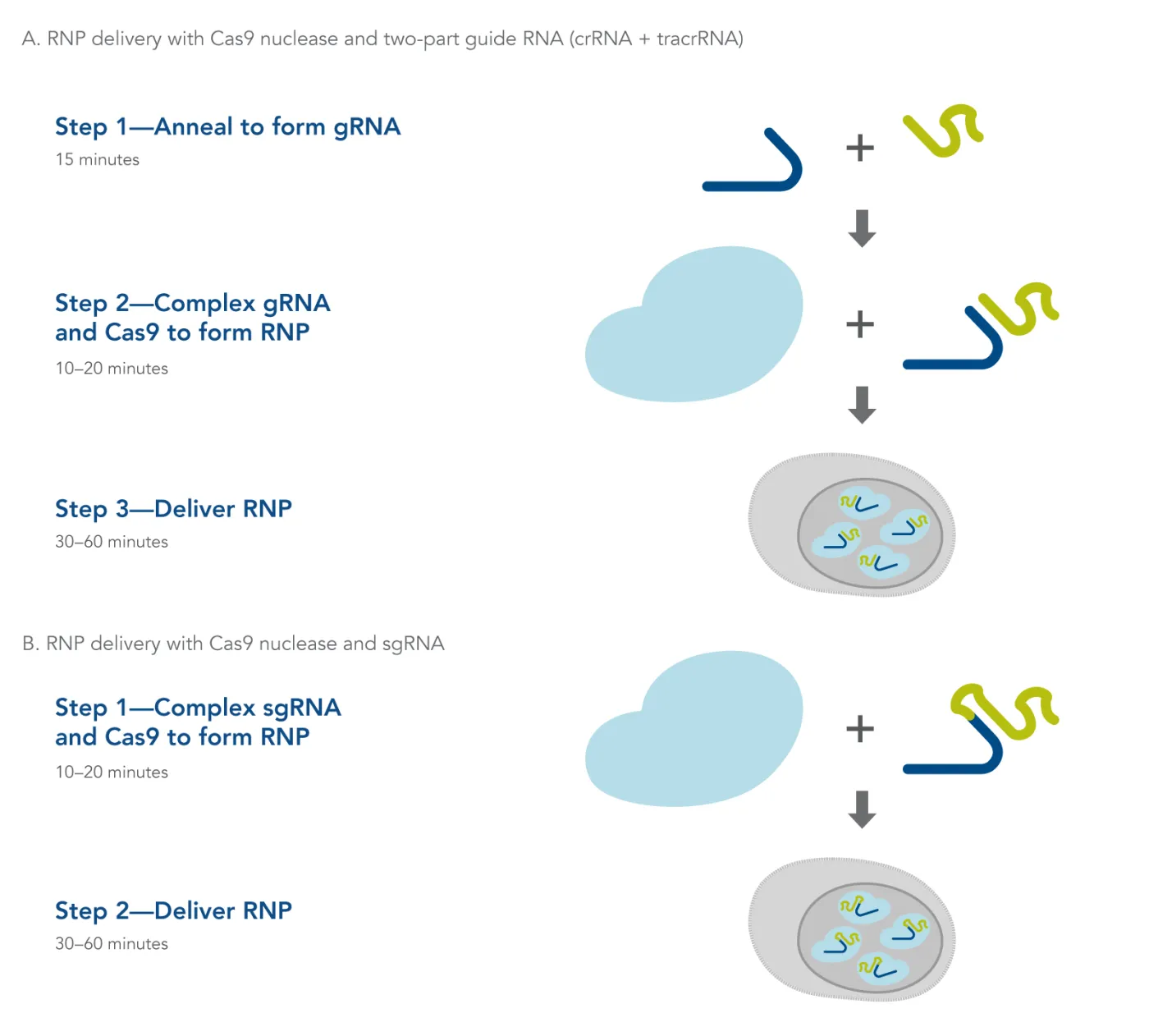
The system is therefore suitable for highly precise and efficient editing of the genome. It uses the Cas9 endonuclease enzyme to create a double-strand break in DNA. The Cas9 endonuclease identifies the target DNA sequence with the help of a CRISPR RNA (crRNA). In addition to the CRISPR crRNA, a trans-activating CRISPR RNA (tracrRNA) is also required to activate the endonuclease and form a functional ribonucleoprotein complex. The crRNA of the native Streptococcus pyogenes system is 42 base pairs long and the tracrRNA is 89 base pairs long. Together, they are therefore necessary to direct the Cas9 endonuclease to the correct target and to cleave double-stranded DNA specifically. The cleaved DNA is then repaired either by non-homologous end joining (NHEJ) or by homology directed repair (HDR), which may result in modification of the original sequence.
The IDT optimized Alt-R CRISPR advanced system uses a shortened, 67-base-pair tracrRNA oligonucleotide and a likewise shortened 36-base-pair crRNA to achieve the most precise possible editing of the double-stranded DNA target by Cas9 enzyme. The chemically modified crRNA contains a specific protospacer region 19-20 bases long and a 16-base-pair domain that fuses with the tracrRNA. The presence of a so-called PAM (protospacer adjacent motif) sequence is also essential for forming the DNA-RNA complex, both on the target DNA and on the crRNA.
Key features and benefits of the IDT ALT-R CRISPR system
Compared with other CRISPR systems, such as the native S. pyogenes crRNA-tracrRNA complex, the ALT-R CRISPR system offers significantly greater target specificity.
The ALT-R CRISPR system includes purified, codon-optimized recombinant S. pyogenes Cas9 endonuclease produced in E. coli. The enzyme contains 1 N-terminal nuclear localization sequence (NLS), 2 C-terminal NLSs, and a C-terminal 6-His tag. The Cas9 endonuclease with 3 NLSs forms a ribonucleoprotein (RNP) complex with the Alt-R CRISPR crRNA and tracrRNA, which results in very high editing efficiency for most targets. Using the RNP complex can also solve problematic cases that may arise when using mRNA or DNA expression constructs. For example, when using Alt-R S. pyogenes Cas9 endonuclease, the amount of Cas9 delivered into cells can be precisely controlled, and this non-renewable amount of Cas9 can also limit the duration of enzyme activity. Overall, these factors reduce off-target effects. Furthermore, using RNP eliminates the occasional genomic integration that can occur with DNA constructs, as well as the possibility of toxicity from transfected mRNA. You can find the most frequently requested items in the Alt-R CRISPR portfolio at this link.
If you run into problems with the classic CRISPR reaction in your experiments, there is a good chance we can offer a solution! Over the past few years IDT has worked to overcome the limitations of CRISPR technology, starting with the Alt-R Cas12a (Cpf1) enzyme-gRNA system, which works better in AT-rich regions, through HDR donor blocks, developed to increase HDR efficiency, and Custom guideRNAs with unique sequences, all the way to various enhancers that make integration more efficient.
As an example, you can see the properties of different Cas9 enzymes in the figure below:
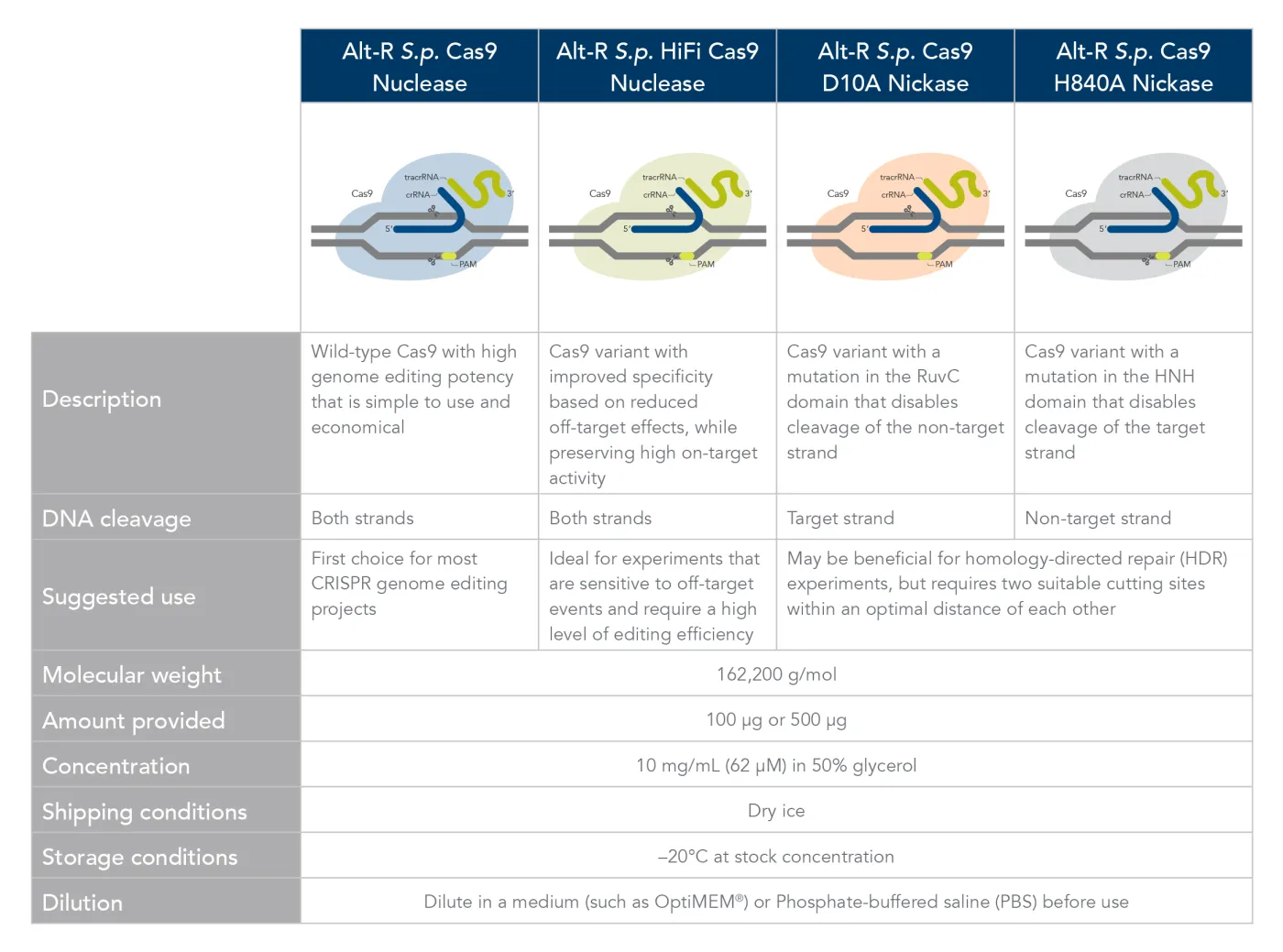
Delivering the ribonucleoprotein into cells can be made highly efficient by lipofection or electroporation. Unlike the Cas9 system transcribed in vitro, this method is non-toxic and does not activate the innate immune response. You can find the electroporation enhancers here under the Enhancers & Controls tab.
Although numerous algorithms exist for designing the 19–20 base protospacer sequence of the crRNA, only some of them produce strong genome editing activity. Data from experiments with the ALT-R CRISPR system show that, despite the lack of sequence design, genome editing with optimized RNAs will be highly specific for most DNA targets.
In the ALT-R CRISPR system, the Cas9 endonuclease primarily enters the cell as part of the RNP, but the system is also compatible with Cas9 enzymes from other sources, for example through cells stably expressing S. pyogenes Cas9 endonuclease or through DNA/mRNA constructs. The separately available Cas9 expression plasmid provides constitutive Cas9 expression under the control of a CMV promoter.
Chemical modification of the crRNA in the ALT-R CRISPR system protects the crRNA from degradation by cellular RNases, while chemical modification of the tracrRNA gives the molecule increased nuclease resistance and further improves target specificity. The chemical modifications will automatically be included in the sequence of the ordered Alt-R CRISPR crRNA oligonucleotide.
The control kit contains an Alt-R CRISPR HPRT positive control crRNA specific for the HPRT (hypoxanthine phosphoribosyltransferase) gene, and a validated Alt-R CRISPR negative control. The kit also includes Alt-R CRISPR tracrRNA complementary to the control crRNAs, nuclease-free duplex buffer, and validated PCR primers specific to the corresponding HPRT regions of the selected organism. The PCR assay included in the kit makes the system ideal for verifying modification of the HPRT gene.
IDT ALT-R HDR SOLUTIONS
As a pioneer in Homology-Directed Repair (HDR) technology, IDT has developed a donor set that, through various modifications and sequence protection, already significantly increases the desired HDR efficiency while minimizing off-target effects and non-homologous integrations.
For smaller segments, e.g., introducing point mutations, Alt-R HDR Donor Oligos are ideal, while for longer sequences, Alt-R HDR Donor Blocks are ideal.
You can further increase efficiency with HDR enhancers, as the figure below illustrates:

In addition, IDT's traditionally excellent online tools now include the Alt-R CRISPR HDR Design Tool, which makes CRISPR experiments easier!
If we have sparked your interest or if you have any questions, please feel free to contact us!
For research use only. Not for use in diagnostic procedures. Unless otherwise agreed to in writing, IDT does not intend for these products to be used in clinical applications and does not warrant their fitness or suitability for any clinical diagnostic use. Purchaser is solely responsible for all decisions regarding the use of these products and any associated regulatory or legal obligations.